Search This Blog

Monday, May 13, 2013

Fishing - Pulau Jarak Deep Sea Fishing Package


Deep sea fishing in Malaysia offers challenges to anglers to test their skill fishing for tuna, grouper, snapper, barracuda, shark and the blue marlin. Deep sea fishing trips are available at most coastal towns, villages and popular islands in Peninsular Malaysia, Sabah and Sarawak.

All set to go Deep Sea fishing at Pulau Sembilan & Pulau Jarak
Choice of popular fishing spots are Langkawi, Pangkor, Perhentian, Tioman, Temenggor Lake, Cenderoh Lake, Kenyikr Lake, Lake Chini and around rivers and streams in the National Parks of Malaysia.
Let's fish !!!
Pulau Sembilan is a cluster of nine islands situated off the coast of Perak. It is a great fishing spot, only 1 ½ hours from Pangkor Island. This is also the spot of the Pulau Sembilan Fishing Safari, held annually since 1986 by the Perak Fisheries Department as a tourism event. Pick-up points can be at Lumut, Teluk Batik, Manjung or Bagan Datoh. There is no accommodation on the islands, except camping on the beach. 
Morning at sea !!!
Pulau Jarak is only about 4 hours boat ride from Pulau Sembilan, located at the Malaysia and Indonesia international waters border. Snapper or “Jenahak” and Grouper or “Kerapu” are some of the common catch. This tiny island (barely 8 hectares in size) and rises 50 meters above sea level is Malaysia’s latest dive destination. There is no beach on Pulau Jarak, only granite sloping down to the sandy sea bed with small patches of stony, encrusting and soft corals.
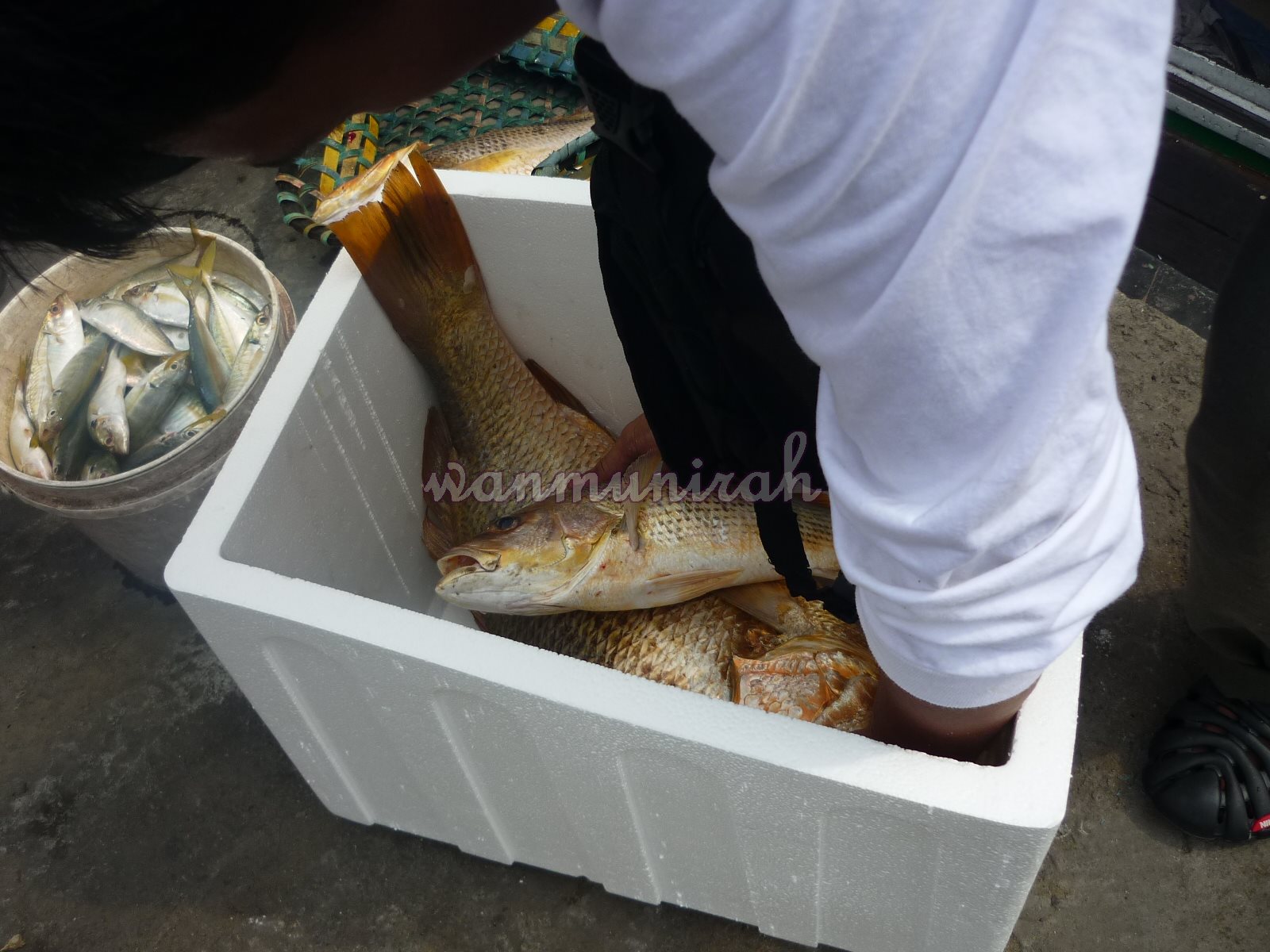
Mr Leong and his catch !!
Suzaiman and his catch !!
FISHING PACKAGES
(Minimum 12 anglers)
Boat type
2 Days 1 Night
3 Days 2 Nights
Luxury boat
RM 290.00
RM 500.00
Normal boat
RM 220.00
RM 420.00

The package includes meals onboard, bed, cook, toilet, rod holder, live bait, life jacket, sauna, GPS, radar and electricity. It excludes fishing gears.

Tentative 2D1N program
Day 1
10.00am - arrive at Kg Acheh jetty, Sitiawan.
11.00am - proceed for 45 minutes journey to Sungai Pinang Besar jetty, Pulau Pangkor. You will have your own lunch.
11.45am – proceed to Ship Wreck site (2 to 3 hours journey) to fish for live baits. Once there are enough live baits, bottom fishing begins
6.00pm – dinner
11.00pm – supper
Day 2
9.00am – proceed back to Kg Acheh jetty and estimated to arrive at 12.00noon


Tentative 3D2N program
Day 1
Similar as 2D1N program
Day 2
9.00am - breakfast
6.00pm – dinner
11.00pm – supper
Day 3
Similar as Day 2 for 2D1N program

If you have any questions, please email us at leisureincentivetours@gmail.com or call us at 03-2260 3667 / 4667. More photos in our Facebook company Leisure & Incentive Tours Sdn Bhd

Monday, April 29, 2013

Wan, the Rookie angler, and her Pulau Sembilan Fishing trip


Does anyone have any idea of the meaning of Angling Tourism? When I goggled under Angling, it states that “it is a method of fishing by means of an angle (fish hook)”. Well, according to Thesaurus, “Angling is fishing / casting / trawling / harpooning / whaling / spinning / fly-fishing.” Of course, I know the meaning of Tourism because it is my “bread and butter” since 1989, not counting the joy of travelling during my student years. Put 2 and 2 together, to me the meaning of Angling Tourism is a fishing trip, using whichever method of catching fish, either for novice or die-hard angler, with a sole purpose of recreation.

Bearing that in mind, this will be my first fishing trip and I am ever willing to take on any challenges at sea, I gladly accept the invitation from Tourism Malaysia Perak and Gaya Travel Magazine, as the official media, to go to Pulau Sembilan and Pulau Jarak from 22 – 23 April 2013. 

Tourism Malaysia Perak's Angling Tourism 2013
When we arrived at “Lembaga Kemajuan Ikan Malaysia” (LKIM) jetty at Kampung Acheh, Sitiawan, our 3 boats were ready. Two boats are for the guys with very basic sleeping and toilet facilities.

1st guy's boat
2nd guy's boat

Front of the 2nd guy's boat
Back and kitchen of 2nd guy's boat
Fishing Vessel
However, my boat “Sea Gull” is a “leisure” fishing vessel by comparison.  
  • Sleeping arrangement – There are 5 double-decker individual sleeping space. Only pillows are provided. As for the lower deck, an exhaust fan at the first bunk helps to cool the area. At the side of each sleeping space, there is a small slot that you can store your belongings such as book, digital camera, spectacles, face towel, bottle water and medicated oil.   
Sleeping space at "Sea Gull" boat
Lower sleeping space of "Sea Gull" boat
As comparison, sleeping space of the other boat
My choice of sleeping space  

Me and my sleeping space on "Sea Gull" boat
I slept on 1st bunk of the upper deck. I remembered my husband’s tip to avoid sea sickness while onboard a boat – ask for a cabin on the upper deck or toward the front of the boat. After lunch at a local restaurant in Pulau Pangkor, I had a sound sleep when the boat was heading towards Pulau Sembilan. The journey took about 1 hour. But once the anchor was lowered at the fishing ground near Pulau Sembilan, whenever I try to sleep, I feel queasy due to the sway motion of the sea current. So I had to slide the window open and let the sea breeze in and also switch on the small fan to improve the air ventilation. 

  • There is a very neat and well-kept Indoor kitchen with drinking water. Even the dishes, cups and utensils are kept in a covered dish drainer rack.  
Kitchen of "Sea Gull" boat

Kitchen of "Sea Gull" boat

  • The toilet is spacious with sitting toilet bowl and cold shower and is only operational when the boat is moving. I don’t have any photo of the toilet because whenever I am in the toilet, the sea motion seems to be like tsunami wave. That’s why my time spent in the toilet is very minimal. I confessed that I didn’t take a shower but that’s okay because the fishy smell overpowered my body odour! 

However, I have a photo of the toilet of the other boat. 

Toilet and kitchen of the other boat
By comparison, “Sea Gull” toilet is double the size and is indoor. According to the tour operator Mr Miezie, indoor toilet is safer because if you are groggy and needs to throw up in the toilet, you would not go overboard, especially at night.
  • The deck wood railing is knee high which enable you to sit comfortably and not topple in the sea. 
Deck of "Sea Gull" boat
  • There is also a spacious multi-purpose area at the lower deck for praying, resting, sleeping etc. 

Lower deck of "Sea Gull" boat
  • There are electrical sockets for you to charge your mobile phone or any other electrical appliances. The power supply is on from 6.00pm to 6.00am
Enough of the facilities of “Sea Gull” boat! Oh yeah, in the near future, owner Mr Leong says the boat will be air-conditioned.

Sea sickness
Let me focus on motion sickness and its prevention. I remembered the worst experience during my 1st long haul flight to San Francisco when I vomited nonstop. I was dehydrated and exhausted since I can’t sleep while throwing up, had sore throat from constant vomiting and a general feeling of malaise as I am not able to keep down any food. 

No way, I want to relive the same experience through this Pulau Sembilan fishing trip! Lucky for me, I am quite okay. I only vomited twice in a small quantity and manage to control the intensity of my sea sickness bearing in mind the few following pointers.
  • I avoided heavy, greasy meals and carbonated drinks before the trip. If I do vomit, I’ll at least be able to expel something besides stomach bile, which hurts bad as it comes through my throat by itself.
  • I had small portion of my meals; sumptuous buffet dinner of fresh fired fish, fried leafy “Sawi” with salted fish, dried curried crabs, buttered prawns and omelette; 
  • Dinner on "Sea Gull" boat
    tasty prawn fried rice for supper and “Cintan” Instant Noodle Soup with egg and vegetable for breakfast.
  • Before I vomited the second time, I managed to plug my nose before throwing up to prevent the vomit from clogging and paining my nostrils. And it also keep the smell of vomit out of my nose – that unlovely aroma can cause psychosomatic vomiting!
  • Whenever I felt uneasy, I would sit at the front of the boat to let the sea breeze blow toward my face.
  • When on deck, I kept my eyes focus at a distant horizon, trying very hard to avoid the motion of the sea current. It helps to divert my attention on the flock of sea gulls soaring to catch the fishes at the surface of the sea. The screaming sea gulls are music to my ear, at the spur of the moment!
  • When I am inside, I try to restore my sense of balance. Sometimes it is very difficult, so it is either lie down or go outside.

Enough of “Sea Gull” and Motion Sickness, now back to the fundamental of my Pulau Sembilan Fishing trip. Being a rookie, it is best I show the photos of its tackle, method and tips of Apollo Fishing.

Apollo fishing tackle

An Apollo Fishing tackle
It has a digital indicator of the depth of the line in the sea. To reel in the line, you can either use the manual spool or just press the automatic button. At the end of the line, a 7 Apollo hooks which has pieces of white / shiny paper / plastic near the hooks are attached before the sinker.

Apollo fishing method

First I simply dropped the line using the automatic button to a good depth whilst observing the digital indicator, maybe between 25 to 30 meters. I touched the tip of my finger at the line spool to ensure that the line doesn’t tangle.  At the same time, I let my right hand “feel” the rod and watch out if the end of the rod sags when the fishes are “biting”. 

1st step - Cast line
At my first attempt, the bait fish hooked almost at once! I imagined the school of fishes is attacking these hooks together, thinking that the shiny paper or plastic is food. When I reeled in the line, I was ecstatic at sight of my 3 “ikan selar kuning” or yellow stripe trevally fish. Not bad for a newbie like me!!
My 1st Apollo catch
Next step - unhook the fishes
If you ask me, this so-called “Apollo fishing” is a joy in itself, especially for a beginner like me, because I can hook a few  fish at any one time – or none at all – and likely with some luck, I will hook quite a few more as well.

Tips of basic Fishing

After few successful tries. I learnt a thing or two about basic fishing method – reeling in and unhooking.

A tip I learned from Mr Miezie is once you feel the fishes tugging on your line, quickly reel them in. Otherwise, your Apollo hooks will cluster, making it very difficult for you to entangle them and end up disposing and replacing them with a new set of hooks. Another tip is when reeling the line, first execute it automatically. Stop the line when you see the first fish at sea level, at that instant you do it manually. When the sinker is visible, gently pull the line towards you.

Unhooking the fishes
I have to be extra careful that the hooks doesn’t sting me, hence it is best to work upwards and lower the line to the deck each time. Once the hook got stuck at the back fin of the fish, it is easy to unhook! If stuck in the mouth – which is the normal case, I am always gentle so that I don’t hurt the fish and myself so much. Once the hook is off, I have to be quick to place it in the pail full of water or just let it squirm on the deck. Once it squirm through the small hole and was safe in the sea again. Fresh fish is very slimy and the smell on your hand is lasting.

Lastly, honestly I find this trip to be refreshing and educational. I would love to go on another fishing trip, somewhere else - maybe at Lake Kenyir, Langkawi or Terengganu - encountering different water conditions, using any other fishing methods but on one condition – it is a day or an overnight trip.

Please surf for our Pulau Sembilan Fishing package is in our website http://www.litourssb.com and http://www.leisureincentivetours.webs.com. More photos in our company Facebook page Leisure & Incentive Tours Sdn Bhd. Contact us at leisureincentivetours@gmail.com or call us at 603-2260 3667 / 4667 or fax at 603-2260 5667

Monday, February 25, 2013

Sabah's Multi Cultural Dance Performance


Sabah has the largest indigenous ethnic group with 55 different languages and about one hundred different dialects. Among the 32 ethnic groups are the Kadazan Dusun, Bajau, Murut, Suluk, Malay and Chinese. Each group has their own culture traditions and customs, resulting in a rich multi dance rituals, song and unique traditional costumes.

DALING-DALING AND IGAL-IGAL DANCE

This dance is famous among the Suluk community from the east coast of Sabah, Semporna. The Suluk or Sea Bajau is seafaring people in this part of the world’s most beautiful beaches and the renowned Sipadan Island.

The handsome couple of the Daling-Daling dance
It is a Suluk love story between the Prince and Princess of Bohey Dulang. A beautiful and lively courting dance called ’Daling-Daling (derived from the English word Darling). The Prince seems to do the ‘Silat (Malay martial art) to woo his sweetheart! This dance is usually performed during festivals, wedding ceremonies and also used to welcome guests.

The Princess wears full custom accessories from head to toe; the Crown called ‘Mahkota’, long finger nails called ‘Janggal’ and a Sash or Shawal known as ‘Sablai’. Whereas the Prince wear a distinct tall headdress called ‘Tengolok’

The Igal-Igal is similar to’Daling-Daling’ in terms of costumes and origin, the difference is that there is no Prince and Princess. It is accompanied by the sounds of traditional music instruments called ‘Kulingtangan’, ‘Canang’, ‘Gendang’ and three different types of Gong. The dance is very similar to ‘Daling-Daling’ but is more graceful and is normally performed in the Regatta Lepa ceremonies where the Bajau will decorate their ‘Lepa’ or boat with colorful flags.

SUMAZAU PENAMPANG

The Sumazau dance is a very well-known dance among the locals and is the traditional dance of the Kadazan Dusun community in Penampang. The Sumazau means dance in the Kadazandusun language is usually performed in the month of May during the Harvest Festival or ‘Pesta Kaamantan’.

The female Sumazau dancer
The female dancer wears a black traditional dres called ‘Sinuanga’ accompanied with two chain belts called ‘Himpogod’ and ‘Tangkong’ and a crossed red sash called ‘Sandang’ around their shoulders. The ‘Himpogod’ is made with coins whereas the ‘Tangkong’ with rings.

The male and female Sumazau dancers
The male dancer are dressed in black with a colorful piece of cloth around his waist called ‘Hinonol’, a head dress on his head called ‘Siga’ and a bundle of dried leaves sling across his shoulder called ‘Is’aad’.

The captivating Sumazau dance
I wish I can fly ...
The dances perform in pairs with the male dancers leading the way during the dance. Both male and female dancers start off with rhythmic movements on slightly bent knees and arms swinging by the sides. With a loud cry ‘Pangkis’, the male dancer will lift his arms likes wing outstretched and change his step to the alternating ‘sole and toe’ movement with the female following suit a gentler manner

THE CHINESE FAN DANCE 

The graceful Chinese Fan dance
The origins of the Chinese fan dance can be traced back to the era of the Han dynasty, which dates back around 200 A.D. The Chinese Fan Dance or ‘Xan Tze Wu’ is a representation of beauty, grace, skill, traditions and history. This creative Chinese dance can still be performed to entertain people during festive celebrations such as during the Chinese New Year or during wedding ceremonies or any social occasions.

JOGET SABAH

The courting couple of the Joget Sabah dance
The lively Joget Sabah dance
The Joget is a traditional Malay couple dance and the tempo is fairly quick wit the feeling of teasing and playing between the partners. It was influenced by the Portuguese dance of Branyo which is believed to have been spread to Melaka during the era of the spice trade. The dance is performed at cultural festival, wedding and other social occasions.

BAJAU DANCE

The male dance wears a head dress on his head called ‘Tanjak’ and a piece of cloth around his waist called ‘Selendang’ whereas the female dancer, the head dress is called ‘Sarempak’ which gold in color.

Welcome dance and Kuda-Kuda dance
As for the Welcome dance is only performed by the female dancer to present colorful food cover made from ‘Silad’ leaves, the famous traditional handicraft of the Bajau Sama tribe.

The ‘Kuda-Kuda’ or Horse dance id performed by the male dancer. On the left hand, he will hold a traditional spear called ‘Bujak’ and on his right hand, he will hold a horse whip called ‘Pasut’. He will dance energetically by moving around the stage with great skill by imitating the movement of the horse.

Kuda Pasu dance
The ‘Kuda Pasu’ or Porcelain Horse is performed by couples. It was originally preform by skilled horsemen of the Bajau tribe and inspired by the horses of the tribe.

In this dance, the hands of the male dancers are slightly more angular by bending at the elbow and wrist with the palms flat. The back of the wrist of one arm is placed at the hip while the other is held around the shoulder level.

The female dance uses a pair of scarves that they swing in a vertical circle beside her body or in semi circles with her arms loosely at the sides of her body.

The Bajau dance is accompany the traditional musical instrument called ‘Kulintangan’ which is a set of nine small kettle gongs, three hanging gongs and two double headed drums called ‘Gandang’. All the dancers will dance to the beat of the traditional musical ‘Bertitik’ rhythms called ‘Tigad-tigad’.

MAGUNATIP DANCE

The Magunatip dance is performed by the indigenous people of the interiors of Sabah, including the Dusun of Tambunan, the Kujiau Dusun of Keningau and many of the Murut ethnic groups.

Magunatip is derived from the word ‘Atip’ which mean ‘to press between two surfaces’. Two bamboo poles are laid across and are hit and clapped together while the dances, first test the waters with their toes, leap in and out the clapping poles, first alone then with their partners. It is dance of happiness performed at social occasions and to honor distinguished guests.

The female dancers of the Magunatip dance
The dancers of the Magunatip dance
The skilled male dancers of the Magunatip dance
Guests trying their luck at the Magunatip dance
Photography session with the Magunatip dancers
If you wish to go to Sabah and experience their lifestyle, please contact us at 03-2260 3667 / 4667 or email us at leisureincentivetours@gmail.com. 

There are more photos in our Company Facebook page - Leisure & Incentive Tours Sdn Bhd